I moved my feeder three times in one season before I got it right. The first spot was a sunny corner near my patio door, convenient for refilling but exposed all afternoon. Visits were sparse, and the nectar was cloudy within two days. The second spot was tucked into a dense shrub, which felt more natural, but the birds barely found it. The third spot stuck. I’ll explain why as we go.
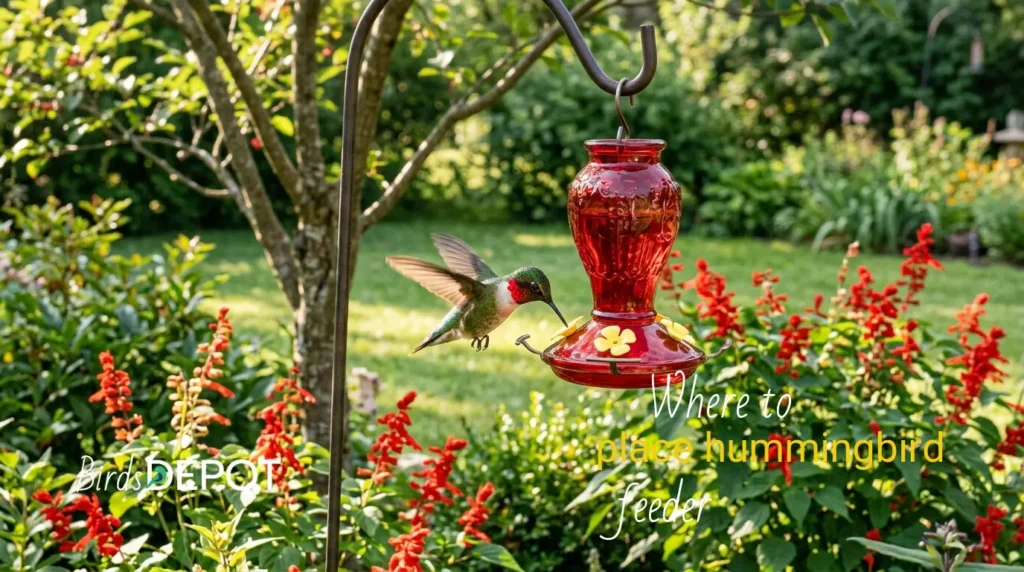
Most placement advice you’ll find online repeats the same numbers without telling you which ones come from actual ornithology research and which ones are just widely-repeated hobbyist consensus. That distinction matters, especially on the window-safety question, where some sites are genuinely getting the numbers wrong. This article covers height, shade, shelter distance, window placement, and what to do when you’re running multiple feeders.
How High Should You Hang a Hummingbird Feeder?
The number you’ll see most often is 4 to 6 feet above ground. That’s practical consensus from birding retailers and hobbyist guides rather than an ornithology-sourced figure, but it holds up in practice for two clear reasons.
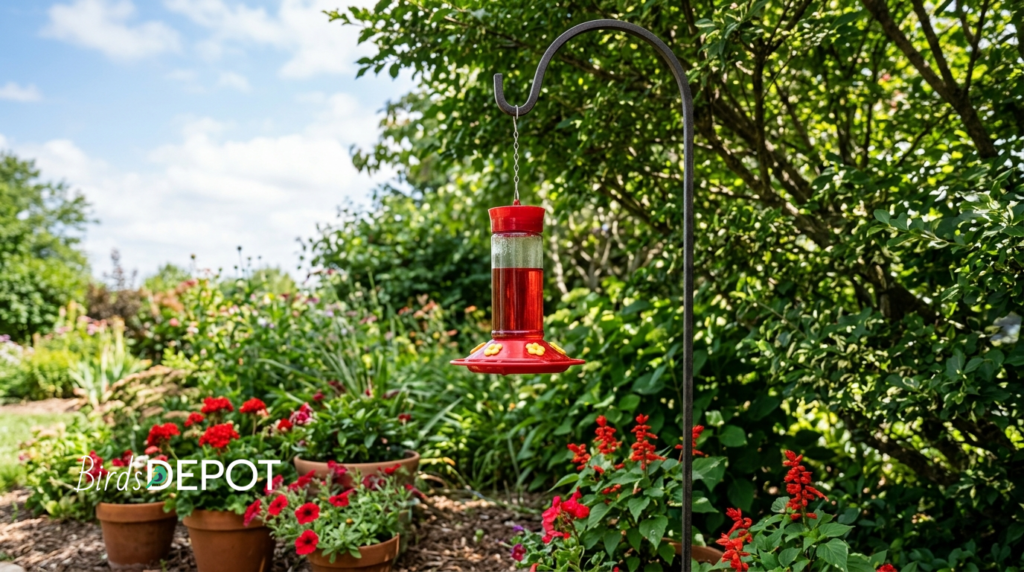
Below 4 feet, a feeder is within reach of a cat’s jump. Cats can leap from a crouch to around 5 feet, and a hummingbird hovering at a low feeder has nowhere to go quickly. Above 6 to 7 feet, you start creating real problems for yourself at refill time, and there’s no meaningful benefit to the birds. Hummingbirds forage at flower height, which is typically 3 to 6 feet, so a feeder in that range fits naturally into their search pattern.

ANIDEER Shepherds Hooks for Outdoo
Heavy-Duty Bird Feeder Pole with 7-Prong Base
A sturdy 72-inch adjustable steel shepherd's hook featuring a reinforced 7-prong base for added stability. Ideal for hanging bird feeders, hummingbird feeders, flower baskets, lanterns, wind chimes, and seasonal outdoor decorations.
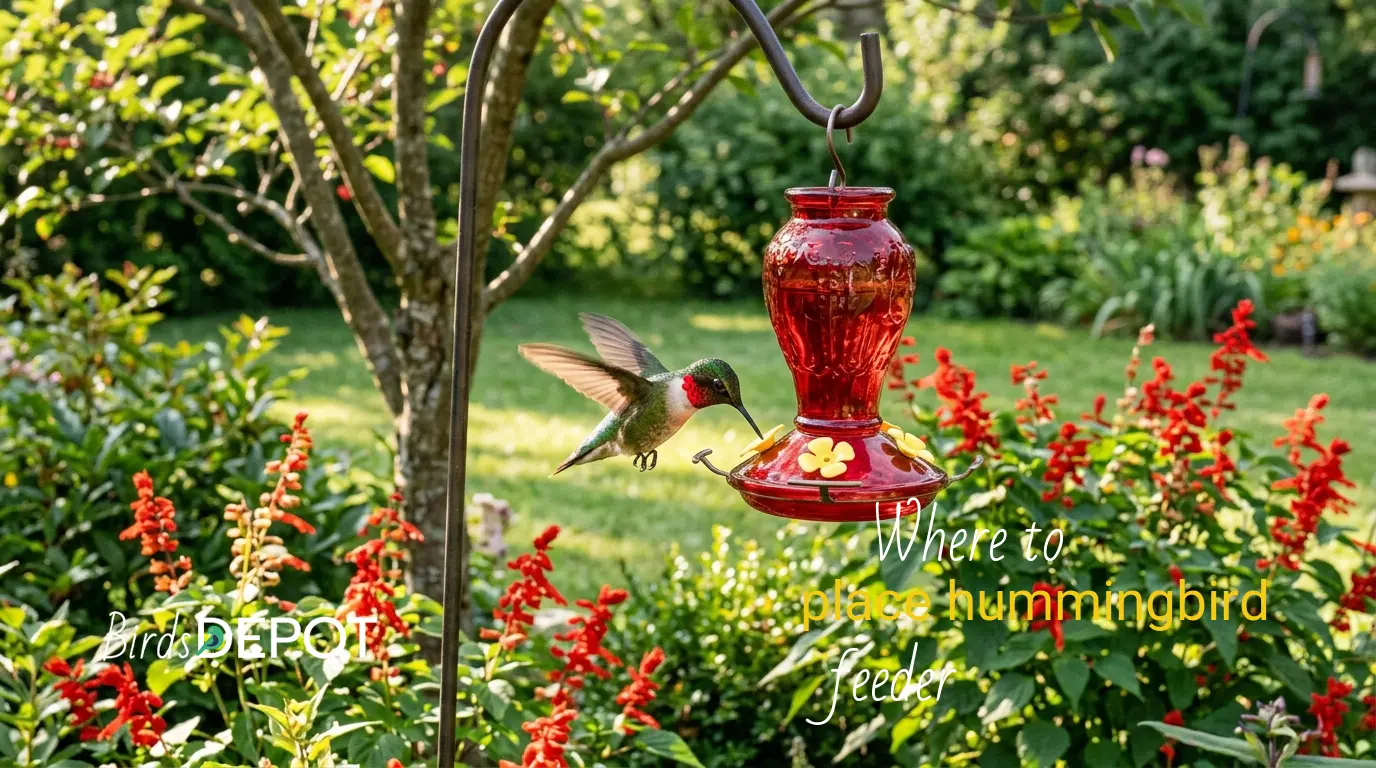
A shepherd’s hook planted in a garden bed is one of the simplest ways to hit this height reliably. The feeder hangs free, you can move it without tools, and there’s no wall or overhang blocking the birds’ approach from any angle.
Sun, Shade, and How Fast Your Nectar Spoils
Afternoon shade is the one placement factor that directly affects how often you’re cleaning your feeder. A feeder in full sun all day can have nectar turning cloudy or fermenting within 24 to 48 hours in summer heat. Move it to a spot with morning sun and afternoon shade, and you’ll often stretch that to three or four days before a change is needed.
Morning sun has a secondary benefit: it warms the nectar slightly and makes the feeder more visible as light hits it early in the day. Hummingbirds have sharp eyesight and pick up color and reflection well. A feeder that catches the low morning light stands out. One that bakes under noon sun just spoils faster.
Dappled shade under a tree works better than deep shade from a solid structure. Deep shade from a roof or awning can make the feeder genuinely hard for passing birds to spot, especially early in the season when they’re exploring new territory. If you want to understand how often to clean your feeder based on temperature and conditions, that’s worth reading alongside this.
How Close Can a Feeder Be to a Window?
This is where most placement guides either oversimplify or get the numbers wrong. The safe zones, per Cornell Lab’s All About Birds guidance, are within 3 feet of the glass or beyond 30 feet. The danger zone is everything in between. According to Audubon Portland, “Around one billion birds die every year due to collisions in the United States; among them, 54-76% of window collisions are deadly.”
The reason is physics. A bird that strikes a window within 3 feet of where it was perched, or while feeding, hasn’t built up enough speed to injure itself badly. A bird that hits glass from 30 feet away is approaching at full flight speed, which can be fatal. The 5 to 30 foot range is where most window-strike deaths happen, because the bird has enough distance to accelerate but not enough time to see the glass as a barrier.
I’ve seen at least one popular birding site state the cutoff as “within 3 feet or beyond 10 feet.” That’s not the figure Cornell or the American Bird Conservancy uses. The 30-foot threshold is the one backed by consistent guidance from both organizations, and the 10-foot version is just wrong.
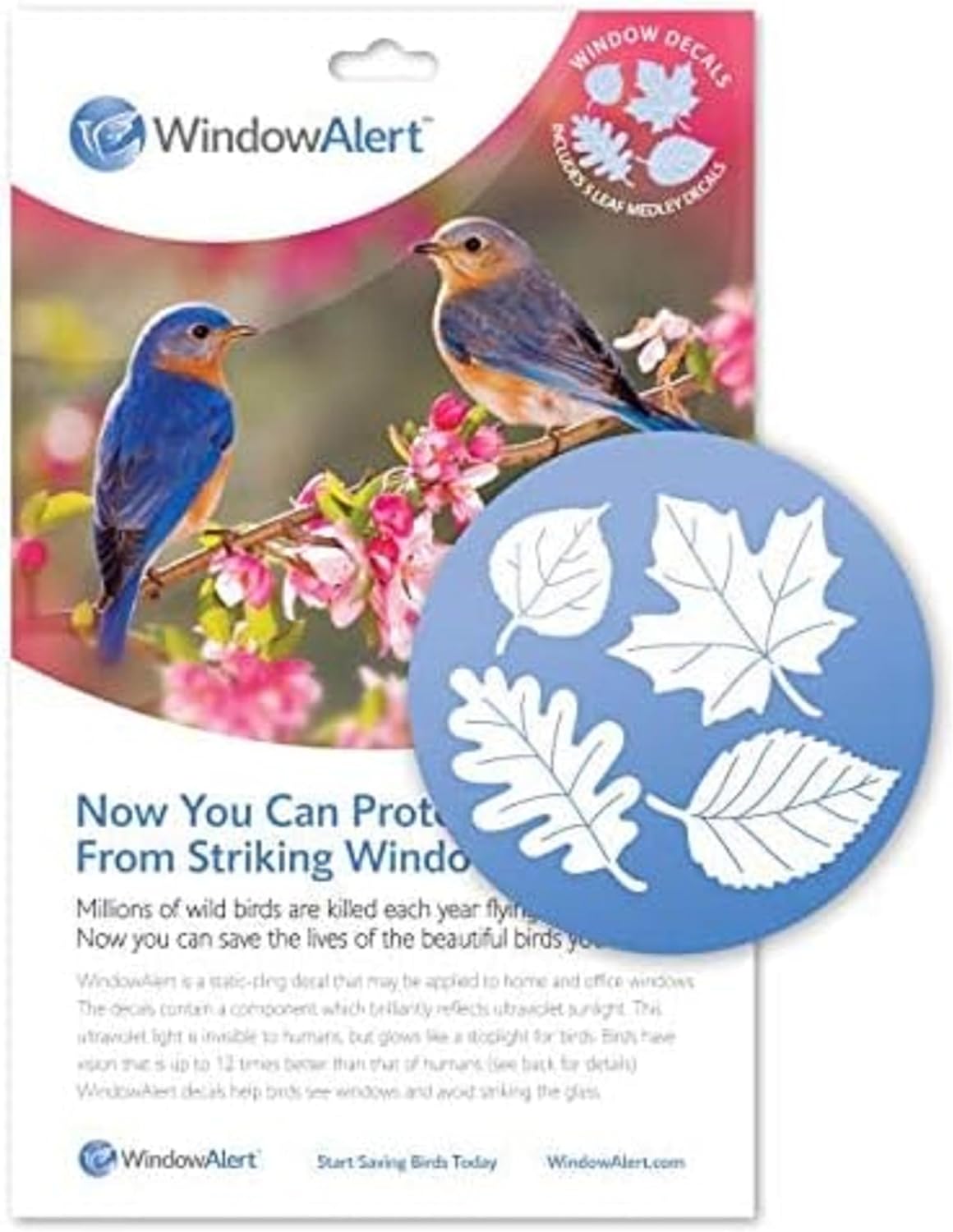
WindowAlert Leaf Medley Anti-Collision Decals
UV-Reflective Static Cling Window Decals
Amish-crafted recycled plastic feeder built to last decades, perfect for woodpeckers, crows, and Blue Jays with easy-open roof and generous perching space
One more thing worth knowing: the American Bird Conservancy’s actual position is more conservative than the 3-foot/30-foot rule implies. ABC states that no feeder distance is fully safe from window strikes without treating the glass itself. Window film, exterior screens, or hanging streamers across the glass all reduce collision risk in ways that distance alone can’t fully replicate. If your best available location falls somewhere in the middle range, treating the nearest window is more effective than trying to measure your way out of the problem.
Project FeederWatch data on feeder-window collisions reinforces this. They don’t prescribe a single safe distance because the variables (glass size, reflectivity, surrounding vegetation) change the risk profile significantly. The practical takeaway: use the 3-foot and 30-foot figures as a real guide, and add window treatment if you have any doubt.
How Close to Shelter Should a Hummingbird Feeder Be?
The commonly cited distance is 10 to 15 feet from a tree, shrub, or dense planting. That’s birding community consensus rather than a figure from Cornell or ABC, but it reflects something real about how hummingbirds actually behave.
Hummingbirds don’t spend most of their time feeding. They perch between visits, often on a small branch within clear sightline of the feeder so they can defend it from rivals. A feeder placed 10 to 15 feet from cover gives them a quick escape route from predators while keeping the feeder itself visible and accessible. Too close to dense foliage and the feeder becomes hard to spot and hard to maneuver around. Hummingbirds hover and circle when feeding, and they need clear airspace on at least two or three sides.
Burying a feeder inside a shrub is one of the most common placement mistakes I see in questions from the birding community. The birds may find it eventually, but they’ll be uncomfortable and visits will be shorter. A feeder near cover, not inside it, is the difference.
Multiple Hummingbird Feeder Placement
Running more than one feeder only reduces territorial fighting if the feeders are out of sight of each other. This is the part most guides skip, or mention briefly without explaining why it matters.
Hummingbirds, particularly males, will claim a single feeder and spend more energy chasing rivals away than actually feeding. If a second feeder is visible from the first, the dominant bird simply expands its territory to cover both and the dynamic doesn’t change. Place feeders around a corner of the house, on opposite sides of a large shrub, or far enough apart that no single bird can monitor both at once.
How many feeders you run is mostly a question of how many you’re willing to maintain properly. More feeders spread nectar consumption across more birds and reduce the intensity of territorial standoffs, but each one needs regular cleaning and refilling. Keeping larger birds from crowding out hummingbirds is a related problem once you start running multiple stations, and nighttime feeder visitors become more likely too if the feeders are left out after dark.
Where Not to Hang a Hummingbird Feeder
A few placement mistakes come up repeatedly, and they’re worth listing plainly because they’re easy to make.
Full afternoon sun. Already covered in the shade section, but worth repeating as a standalone mistake. The nectar spoilage problem is real and it directly affects how willing birds are to return to a feeder they’ve visited before and found fermented.
High-traffic zones. A feeder near a door that opens frequently, a pathway people use multiple times a day, or anywhere a dog runs through will see fewer visits. Hummingbirds habituate to gentle background activity near a window, but they don’t like unpredictable movement close to where they’re feeding.
Dense foliage. The bird can’t maneuver, can’t defend the feeder easily, and other birds can approach from cover. A cat in a dense shrub near a poorly-placed feeder is a real hazard.
Too close to other feeders. A platform or seed feeder nearby will attract house sparrows, starlings, and larger birds that hummingbirds actively avoid. Keep hummingbird feeders separate from general feeding stations.
The middle window range. If your best available hanging spot puts the feeder 5 to 30 feet from a large window, that’s the specific situation worth adjusting. Either move the feeder closer to the glass or treat the window. Fixing a feeder that’s leaking nectar is also worth sorting before finalising placement, since a leaking feeder in the wrong spot attracts insects and other animals faster than one that’s sealed properly. If you’re thinking about whether feeder placement affects bear risk, that’s a separate but real consideration depending on where you live.
Tips for Specific Situations
Balcony Birders
A balcony changes the placement calculation. You’re working with limited space, usually one or two walls, and a railing at a fixed height. The window-safety rule still applies: a feeder hung close to the sliding door or glass panel is safer at under 3 feet than at 6 to 10 feet away. A suction-cup hook on the glass itself, or a railing hook that keeps the feeder within arm’s reach and within 3 feet of the window, usually works better on a balcony than a shepherd’s hook. If you need more ideas for placement options if you don’t have a yard, there’s a full guide on that.
First-Time Feeder Setup
If this is your first feeder and you’re not seeing birds within a week, check visibility before anything else. A feeder in dappled shade that catches morning light and sits near a patch of red flowers (salvias, bee balm, or even red petunias) will get found faster than one placed purely for your convenience. Hummingbirds explore new areas along regular flight paths, and a feeder that interrupts that path visually gets noticed first.
Yards With Cats
Height matters more than anything else here. Four feet is the practical minimum, but 5 to 6 feet is better if neighbourhood cats are active in your space. Avoid shepherd’s hooks near fences or walls a cat could climb to get above the feeder. A pole-mounted feeder with a baffle below it gives the birds a clean feeding zone with no ambush points underneath.
Troubleshooting and Edge Cases
I followed the placement advice but still get no visits
Give it more time than you think you need. Hummingbirds are territorial and habitual. If they haven’t established your yard in their range yet, a new feeder can sit unvisited for two to three weeks even in good habitat. Make sure the feeder is visible from above (hummingbirds scout from a height before descending), and check that the nectar is fresh. A feeder that was left out too long and has fermented nectar will be actively avoided.
My feeder keeps getting emptied overnight
Bats are the most common culprit if you’re in a region where they’re active. Raccoons and bears are also possibilities depending on your location. Bringing feeders in at dusk is the simplest fix. Placement doesn’t solve this one, but it’s a common question once multiple feeders are running.
I can’t find a spot that avoids the danger window zone
Treat the glass. Window film with a UV-reflective or frosted pattern is the most reliable solution when distance alone won’t work. Hanging strips of paracord or biodegradable streamers across the outside of the window at 4-inch intervals also breaks up the reflection enough to reduce strikes significantly. This is the American Bird Conservancy’s recommended approach when placement constraints are fixed.
The placement that’s worked best in my own yard: a shepherd’s hook at 5.5 feet, about 12 feet from a pyracantha shrub, in a spot that gets sun from 7am to noon and then sits in building shadow for the afternoon. I put it within 3 feet of my kitchen window rather than further away. Within four days of moving it to that spot from a sunnier, more exposed location, I went from one or two cautious visits a day to a bird showing up consistently every 15 to 20 minutes.
The window-safety numbers from Cornell and ABC are the ones to trust, and they’re more conservative than a lot of popular guides imply. The rest, height and shelter distance in particular, is well-tested consensus. Good enough to act on, even if it hasn’t been run through an ornithology lab.
Frequently Asked Questions
Four to six feet above ground is the widely-used recommendation. It keeps the feeder out of easy reach for cats, puts it within the height range where hummingbirds naturally forage for flowers, and keeps it accessible for you to refill without a step stool. This is practical hobbyist consensus rather than a figure from Cornell Lab or American Bird Conservancy, but it holds up well in real use.
Within 3 feet of the glass, or beyond 30 feet. The 3-to-30-foot range is where most window-strike fatalities happen, per Cornell Lab’s All About Birds guidance and the American Bird Conservancy. At under 3 feet, a bird hasn’t built up enough speed to injure itself on impact. At over 30 feet, birds can usually identify the glass as a barrier in time. If your best spot falls somewhere in the middle range, treating the window with film or streamers is the most reliable fix.
Morning sun and afternoon shade is the target. Morning light makes the feeder visible and warms the nectar slightly. Afternoon sun is the problem: it accelerates nectar spoilage and can make the feeder unusable within 24 to 48 hours on a hot day. A location under a tree that gets dappled shade from midday onward is better than one under a solid awning, which can make the feeder hard to spot.