A few summers ago, I set up a beautiful glazed ceramic bird bath right in the middle of my garden. Robins loved it. House sparrows splashed around in it every morning. But hummingbirds? Not once. I watched them zip past it dozens of times without a second glance. That’s when I started looking into what hummingbirds actually need from a bath, and the answer surprised me.
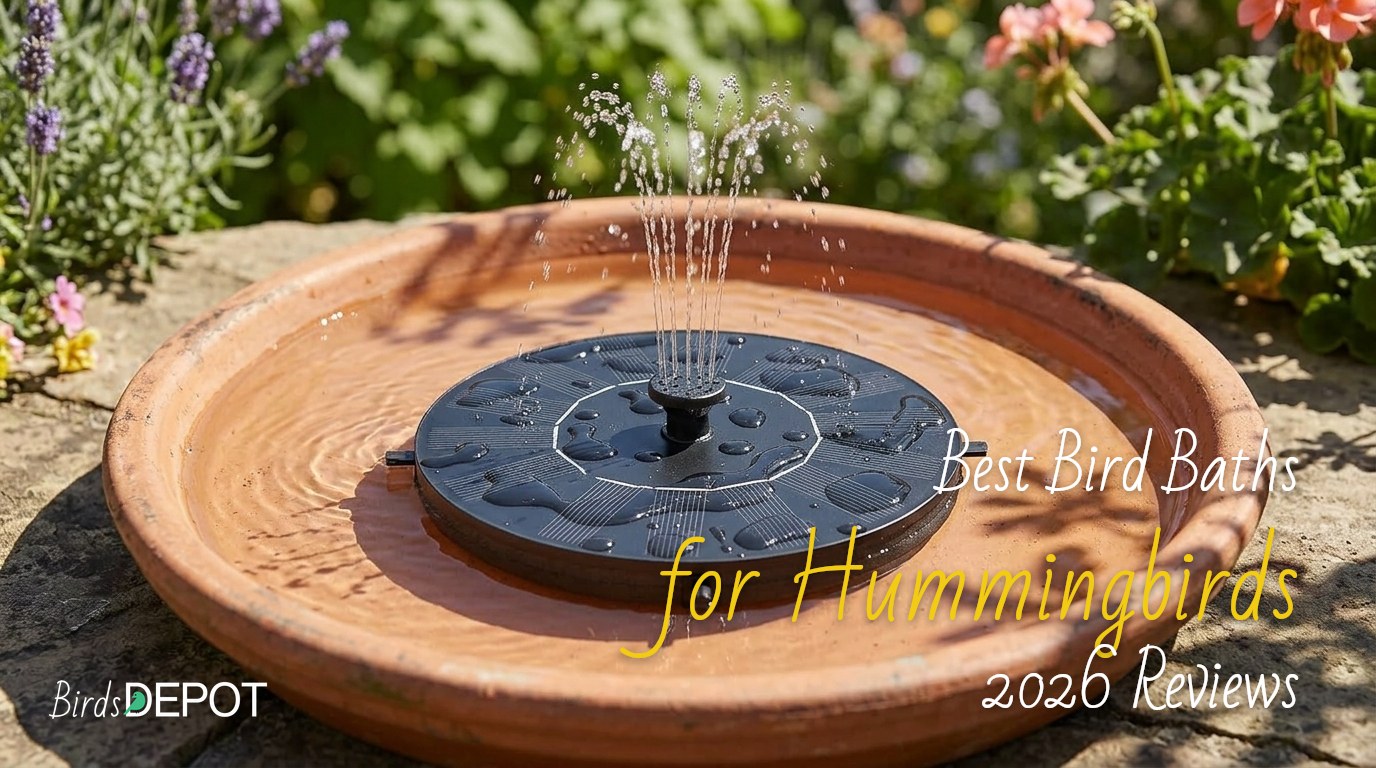
Most bird baths are built for larger birds. The water is too deep, too still, and too exposed for a bird that weighs less than a nickel. Hummingbirds don’t really sit and splash. They bathe in flight, passing through mist or rubbing against wet leaves. A still basin of water three inches deep looks nothing like rain. So they ignore it.
For this roundup, I tested two products myself in my own garden. The solar fountain pump has been running in my bird bath basin for two seasons. The Daoeny metal bird bath has been sitting in my back garden since last spring. The other three, I seriously researched before making my choices. I read through hundreds of reviews, compared specs, and spent more time than I’d like to admit on birding forums. Everything below reflects that honestly.
Do Hummingbirds Actually Use Bird Baths?
Yes, but not the way a robin does. Hummingbirds bathe in flight. In the wild, they fly through light rain, hover in the mist near waterfalls, or rub their feathers against wet leaves. They’re not built to sit in a puddle and splash around.
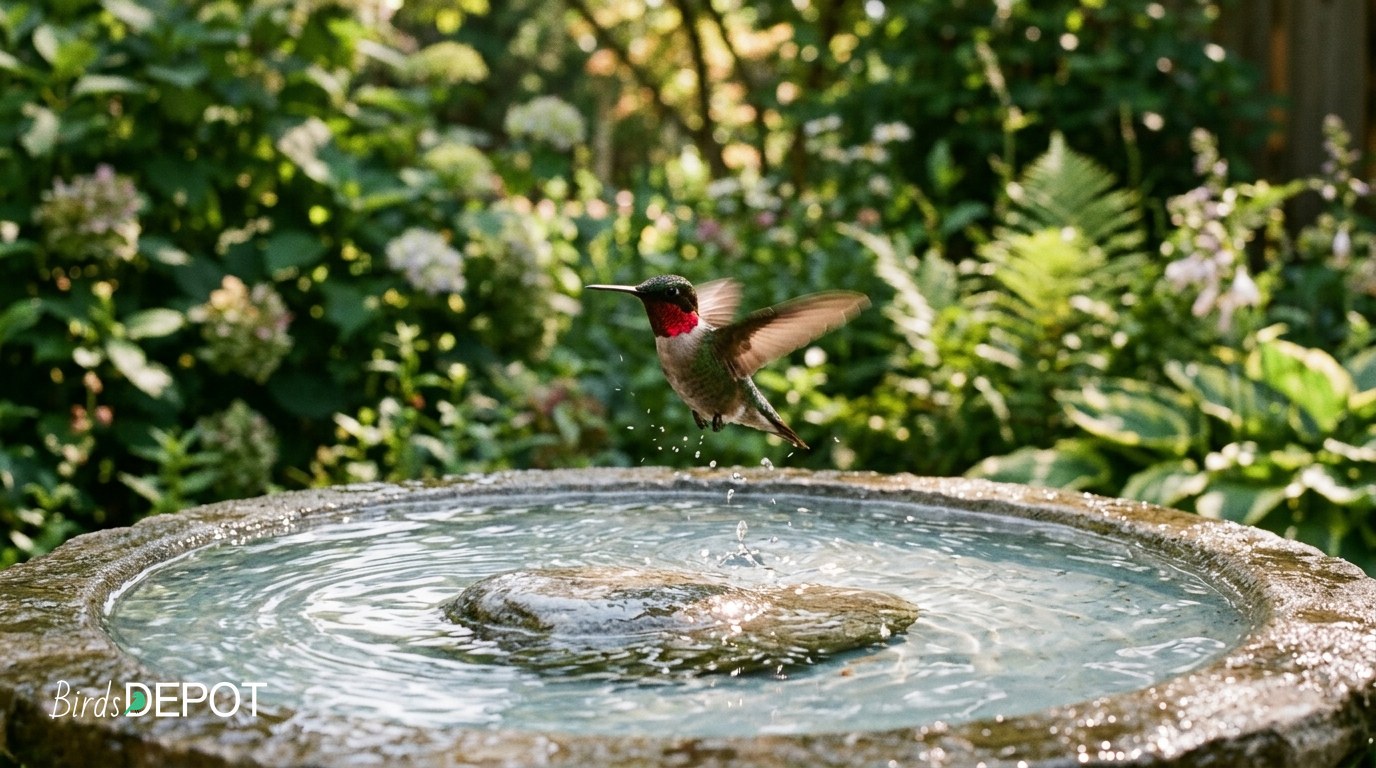
What that means practically: a still, deep basin won’t do much. But add movement and keep the water shallow, and hummingbirds will show up. A solar fountain that kicks up a gentle spray mimics exactly the kind of misting they seek out naturally. That’s the key insight every plain-bath buyer misses.
What Water Depth Actually Works
Keep it between about half an inch and one inch. That’s the safe zone. Deeper water is a genuine drowning risk for a bird this small. Waterlogged feathers lose insulating ability fast, and if a hummingbird can’t touch the bottom, it can lose body heat quickly and can’t recover.
One figure that circulates online puts the safe depth at “0.1 to 0.3 inches,” which reads like false precision. The more credible guidance, referenced from Audubon-sourced advice via Family Handyman, puts the practical limit at around half an inch for plain water. With pebbles or stones added to the bottom, you can go up to an inch or so because the pebbles reduce the effective depth and give the bird something solid to grip.
If your bath is deeper than that, don’t throw it out. Add a layer of smooth pebbles or a flat rock. That simple fix makes most standard baths usable for hummingbirds overnight.
Why Movement Matters More Than the Bath Itself
A mister, dripper, or small solar fountain will outperform a still bath almost every time. Moving water catches the light, makes sound, and mimics the rainfall and waterfall mist that hummingbirds instinctively seek for bathing. Multiple sources, including perkypet.com and birdfy.com, consistently back this up, and it matches what I’ve seen in my own garden.
You don’t need anything complicated. A basic solar fountain pump dropped into an existing shallow basin is often enough. If you already have a bath, a simple mister attachment connected to your garden hose might be all that’s missing. The bath itself matters less than the movement on the water’s surface.
Where to Place It
Not next to your feeder. Territorial male hummingbirds guard feeders aggressively, and that territorial behavior extends to birds trying to bathe nearby. If your bath is three feet from the feeder, the same male who’s chasing rivals away from the nectar will also disrupt birds trying to use the bath.
Put the bath in a different part of the yard entirely. A spot with some nearby perching branches is ideal, so birds can preen after bathing. For more on where to put the feeder itself, that question deserves its own treatment. The short version here: separate the two by as much space as your yard allows.
Our Top Picks for Best Bird Baths for Hummingbirds
- Solar Fountain Pump (1.4W)Best Budget Solar Fountain for Existing Baths
- Daoeny 35-Inch Metal Bird BathBest Freestanding Metal Bird Bath
- AISITIN 3.5W Solar Fountain PumpBest Upgraded Solar Fountain with Separate Panel
- Hanizi Deck-Mounted Bird BathBest for Balconies and Railings
- FLYVOLE 5-Pack Flower Bird BathsBest Decorative Stake-Style Garden Set
The 5 Best Bird Baths for Hummingbirds: Detailed Reviews

Solar Fountain Pump (1.4W)
Best Budget Solar Fountain for Existing Baths
A simple floating solar pump that adds moving water to any shallow basin, no cords or batteries needed.
Pros
- Runs automatically in sunlight with no electricity or batteries required
- Comes with 6 interchangeable nozzle heads to adjust spray height and pattern
- Water-shortage protection stops the pump automatically when water runs low
Cons
- Stores no energy, so it stops completely in shade, clouds, or the moment a leaf lands on the panel
- Requires at least 1.2 inches of water depth to operate, so you need to pair it with a shallow enough basin carefully
Place the pump flat in a basin with at least 1.2 inches of water. When sunlight hits the 1.4W solar panel, the pump starts within about three seconds and pushes water up through whichever nozzle you’ve attached. The filtration box sits under the panel and blocks debris from entering the pump. When water runs low, the pump shuts off automatically to protect the motor.
The panel uses PET laminated construction, which holds up in wet and variable weather better than basic plastic panels. The diameter is 6.29 inches, which fits most standard bird bath basins without hanging over the edge. It’s lightweight enough that the included straws help anchor it and stop it from drifting to one side.
I dropped this into the Daoeny basin (reviewed below) on a clear July morning and watched it start up almost immediately. The spray hit about 40 cm, which was more than I expected at this price. The first hummingbird showed up within two days of me setting it up. I’d had that basin sitting still for weeks with nothing. The moment the water started moving, everything changed. One thing I’ll flag: I did lose a few afternoons of running time when a large leaf blew onto the panel. It stops instantly with any obstruction, which is both a feature and a mild annoyance depending on your garden situation.
The filter cotton and rotor need cleaning every couple of weeks in summer, more often if your garden has a lot of debris. The process is straightforward: remove the nozzle, pull out the pump, take out the filter or rotor, rinse it clean, and reassemble. It takes about five minutes once you’ve done it once.
Who is this for: Anyone who already owns a shallow basin and wants to add movement without running a power cord across the garden. At $8.64, the risk of trying it is basically zero.

Daoeny 35-Inch Metal Bird Bath
Best Freestanding Metal Bird Bath
A sturdy iron bird bath with a wide shallow bowl and a five-pronged base that actually stays upright in the ground.
Pros
- Upgraded five-pronged base resists tipping and holds firmly in garden soil
- 12-inch diameter bowl at 2 inches deep is shallow enough to work for hummingbirds when you add pebbles
- Bowl detaches from the steel ring for cleaning without tools
Cons
- At 2 inches deep, the bowl needs pebbles added before it’s safe for hummingbirds on its own
- Antique bronze finish looks good but will need occasional checks for rust in very wet climates despite the weatherproof coating
Push the five-pronged metal stake into the garden soil until it’s stable. Set the steel ring on top, then place the detachable bowl into the ring. Fill with water, add smooth pebbles to bring the effective depth down to half an inch or so, and pair it with a solar fountain for movement. That combination turns this into a genuinely functional hummingbird bath.
The bowl is 12 inches across and 2 inches deep, made from iron with a safety coating and a black powder-coat finish on the stake. It’s described as stronger than plastic or resin alternatives, and the five-pronged base is a genuine improvement over the older three-pronged designs that tipped in soft ground. Total height is 35 inches, which puts the bowl at a comfortable viewing height from a garden chair.
I put this in the south-facing corner of my garden last spring, which gets direct sun from mid-morning. The antique bronze color blends into the garden in a way I didn’t expect from a product at this price. What struck me the first week was how quickly the bowl got dirty in that spot. There’s a lot of leaf fall near that corner, and the open bowl collects debris fast. But the detachable bowl makes cleaning genuinely easy. I lift it off, tip it out, rinse it at the tap, and it’s back in place in under two minutes. I added a layer of smooth river pebbles from a garden center, and that’s when the hummingbirds started showing interest, especially once the solar fountain was running in the water.
Detach the bowl, rinse it clean, and refill. No tools, no awkward angles. The manufacturer recommends avoiding chemical cleaning products, which is good practice anyway around wildlife water sources. Figure on cleaning it every two to three days in warm weather when algae builds up fast.
Who is this for: Anyone who wants a proper freestanding bath with a stable base, not a lightweight plastic wobbler. Pair it with the solar fountain above, and you have a complete hummingbird setup for under $30.
AISITIN 3.5W Solar Fountain Pump
Best Upgraded Solar Fountain with Separate Panel
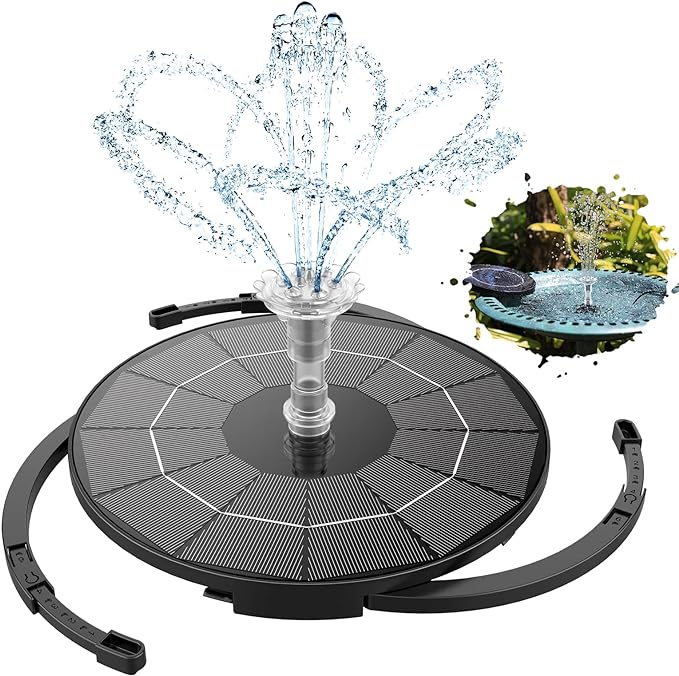
A higher-powered solar fountain with a 9.8-foot cord separating the panel from the pump, so the basin can sit in shade while the panel catches full sun.
Pros
- Separate panel design with a 9.8-foot cord lets you place the basin in shade and the panel in direct sun independently
- Includes more than 8 nozzle options including rotating, double, and vertical styles to control spray direction and prevent water loss
- Retractable anti-drift brackets hold the pump centered in the basin
Cons
- No built-in battery, so it won’t run on cloudy days or in the evening
- Higher price point than the basic 1.4W option for gardens where a simpler pump would do the job
The solar panel sits in direct sunlight while the pump sits submerged in the basin. A 9.8-foot cord connects the two. The pump pushes water up through your chosen nozzle. The retractable brackets clip to the basin edge and hold the pump in the center, stopping it from drifting toward the side and spraying water out of the basin.
The unit measures 9 inches by 8 inches by 2 inches and weighs just under 13 ounces. The body is plastic, black, with the panel rated at 3.5W, which is 2.5 times the output of the basic 1.4W pump. That extra power means a stronger, more consistent spray even on slightly less-than-perfect sunny days.
What kept coming up in reviews was the separate panel design. Almost every complaint I’ve read about basic floating solar fountains comes down to the same thing: a cloud passes, or a shadow falls, and the fountain stops. The AISITIN solves that by letting you position the panel in the sunniest spot in your garden, regardless of where the basin sits. Buyers consistently mentioned the difference this makes for getting continuous flow rather than intermittent spurts. The spec that caught my attention was the 9.8-foot cord length, which is long enough to cover most garden layouts without extension. What made me choose the simpler 1.4W pump in the end was my specific setup: my basin sits in full sun all day anyway, so the separate panel gave me no real advantage. If your bath is in a shadier spot, this one makes more sense.
Same basic process as the 1.4W pump: remove the nozzle, pull out the pump, clean the filter, reassemble. The manufacturer recommends cleaning regularly to prevent clogging from water impurities. The brackets retract when not in use, which makes storage and cleaning slightly less fiddly than units with fixed brackets.
Who is this for: Anyone with a shaded garden or a patio where the bath can’t be placed in direct sun, who wants consistent water movement without running a power cord.

Hanizi Deck-Mounted Bird Bath
Best for Balconies and Railings
A lightweight 12-inch plastic bowl with an adjustable clamp that mounts to deck railings and fences up to 2 inches thick, no tools required.
Pros
- Clamp fits decks and railings up to 2 inches thick and installs without any tools
- Plastic bowl detaches from the steel ring for cleaning and refilling
- Lightweight at 1 pound, so it’s easy to move and reposition
Cons
- No built-in movement feature, so you’d need to add a small mister or fountain to attract hummingbirds reliably
- Plastic construction won’t last as long as metal alternatives in UV-heavy climates
Slide the adjustable clamp onto a deck rail or fence post. Set the steel ring into the clamp, drop the plastic bowl into the ring, and fill with water. The bowl sits at whatever height your railing sits at. For hummingbirds, add smooth pebbles to reduce water depth and a small battery-powered or solar mister to add movement. If you’re working with a balcony instead of a yard, this is the only option in this list designed specifically for that constraint.
The bowl measures 12 inches across, and the whole unit weighs 1 pound. Construction is lightweight plastic with a steel ring and clamp mechanism. At 4.5 stars across nearly 5,000 reviews, it has a strong track record. The “weather-resistant” and “rust-resistant” claims are backed up by consistent positive mentions in the review base, though plastic does degrade faster than metal in direct sun over multiple seasons.
What kept coming up in reviews was how well the clamp actually holds. I expected mounting complaints, but buyers consistently mentioned it stays put even on windy days. The spec that caught my attention was the railing compatibility up to 2 inches thick, which covers most standard deck rails. What made me step back was that I have a garden with ground space, so a freestanding bath made more sense for my situation. If I were setting up a balcony for birds, as I’ve covered separately in my guide to bird feeders for apartment balconies, this would be my first call for a water source.
Detach the bowl, rinse it, refill it, and clip it back in. The whole process takes under two minutes. Because it’s mounted at railing height, there’s no bending down, which is a small but real practical advantage.
Who is this for: Balcony and apartment birders who want to add water for hummingbirds without any ground space.

FLYVOLE 5-Pack Flower Bird Baths
Best Decorative Stake-Style Garden Set
A set of five rust-resistant metal flower stakes that hold water or bird food, designed to attract hummingbirds and finches while doubling as garden decor.
Pros
- Set of five gives you multiple water points spread across a garden, which reduces competition between birds
- Rust-resistant, weatherproof metal coating built for year-round outdoor use
- No tools needed; stakes push directly into soil or lawn
Cons
- Each flower bowl is only 5 inches across, which limits water capacity and means more frequent refilling
- No movement feature and the small bowl size makes adding a fountain impractical
Push each flower stake into the garden soil. The metal flower head holds water in a shallow cup. Because the cups are small and shallow by design, the water depth is naturally low, which actually suits hummingbirds better than most standard baths. You’re relying on the shallow depth and visual appeal to attract birds rather than movement, so placement near natural flight paths matters more here than with a fountain setup.
Each unit is 5 inches by 5 inches by 12 inches and weighs 0.87 kilograms for the full set of five. The top is small enough to keep the bully birds away. The metal is described as eco-friendly with a waterproof, rust-resistant coating. At 23.6 inches tall, they sit low in the garden, which suits ground-level placement near planting beds. The multicolor flower design adds visual interest at ground level, and at 4.4 stars across 357 reviews, it’s a newer product that’s tracking well.
The spec that caught my attention was the five-unit pack. Multiple small water sources spread across a garden are genuinely better for birds than one central bath, because they reduce the chance of one territorial bird dominating the water supply. Buyers consistently mentioned the decorative value alongside the function, and several noted that hummingbirds did visit them. What made me look elsewhere was the small bowl size and the lack of any movement feature. Without a mister or drip nearby, still water in a small cup is a harder sell for hummingbirds than a fountain setup. That said, as supplementary water points alongside a main fountain bath, these make a lot of sense.
Pull the stake from the ground, rinse the flower cup, and refill. The small cup size means this is faster to clean than a full basin, but you’ll be doing it more often because it holds less water and evaporates quickly in warm weather.
Who is this for: Gardeners who want to add several small water points across a planting area, with a decorative stake design that doesn’t require a separate basin or stand.
Final Verdict: My Top Pick
- Best overall setup: The Daoeny metal bird bath paired with the 1.4W solar fountain pump. Under $30 combined, stable, shallow enough with pebbles added, and the moving water is what actually brings hummingbirds in. This is the combination I use and the one I’d recommend first to anyone starting from scratch.
- Best for shaded gardens: The AISITIN 3.5W solar fountain. If your garden doesn’t get uninterrupted sun where the bath sits, the separate panel design is worth the extra cost for consistent water movement.
- Best for balconies: The Hanizi deck-mounted bath. There’s no equivalent option for railing mounting in this list. Add a small battery mister alongside it, and you have a workable hummingbird water setup without any ground space.
- Best decorative addition: The FLYVOLE flower stakes work best as supplementary water points alongside a main fountain setup, not as a standalone hummingbird bath.
- Clear overall winner: The solar fountain pump combined with the Daoeny basin. Movement plus shallow water plus stability, for less than the price of a potted plant. That’s the combination I’d buy again without hesitation.
If you want to build out the rest of your hummingbird setup beyond the bath, that’s the natural next step once the water situation is sorted. Also, make sure to use a bee-proof hummingbird feeder.
Frequently Asked Questions
Yes, but not the way larger birds do. They bathe in flight, passing through mist or hovering near moving water. A still, deep basin often gets ignored entirely. Add movement and keep the water shallow, and hummingbirds will show up.
Aim for half an inch to one inch. Deeper water is a genuine drowning risk because waterlogged feathers cause rapid heat loss, and a bird this small can’t recover if it can’t touch the bottom. Adding smooth pebbles to a deeper basin brings the effective depth down and gives birds solid footing.
Consistently, yes. A solar fountain, mister, or dripper outperforms a still bath almost every time. Moving water mimics rain and waterfall mist, which is what triggers natural bathing behavior in hummingbirds. If you can only do one thing to improve an existing bath, adding movement is it.
No. Territorial males guard feeders and will disrupt birds trying to bathe nearby. Keep the bath in a separate part of the yard. For more on where to put the feeder itself, that decision involves a few other factors worth thinking through separately.
You can, with a simple fix. Add a layer of smooth river pebbles or a flat rock to bring the water depth down to under an inch. Then add a small solar fountain or mister for movement. That combination turns most standard baths into something hummingbirds will actually use, without buying anything new. Keep an eye on your feeder’s cleaning schedule too, because the same algae and bacteria that build up in feeders will build up in a bath even faster in warm weather.