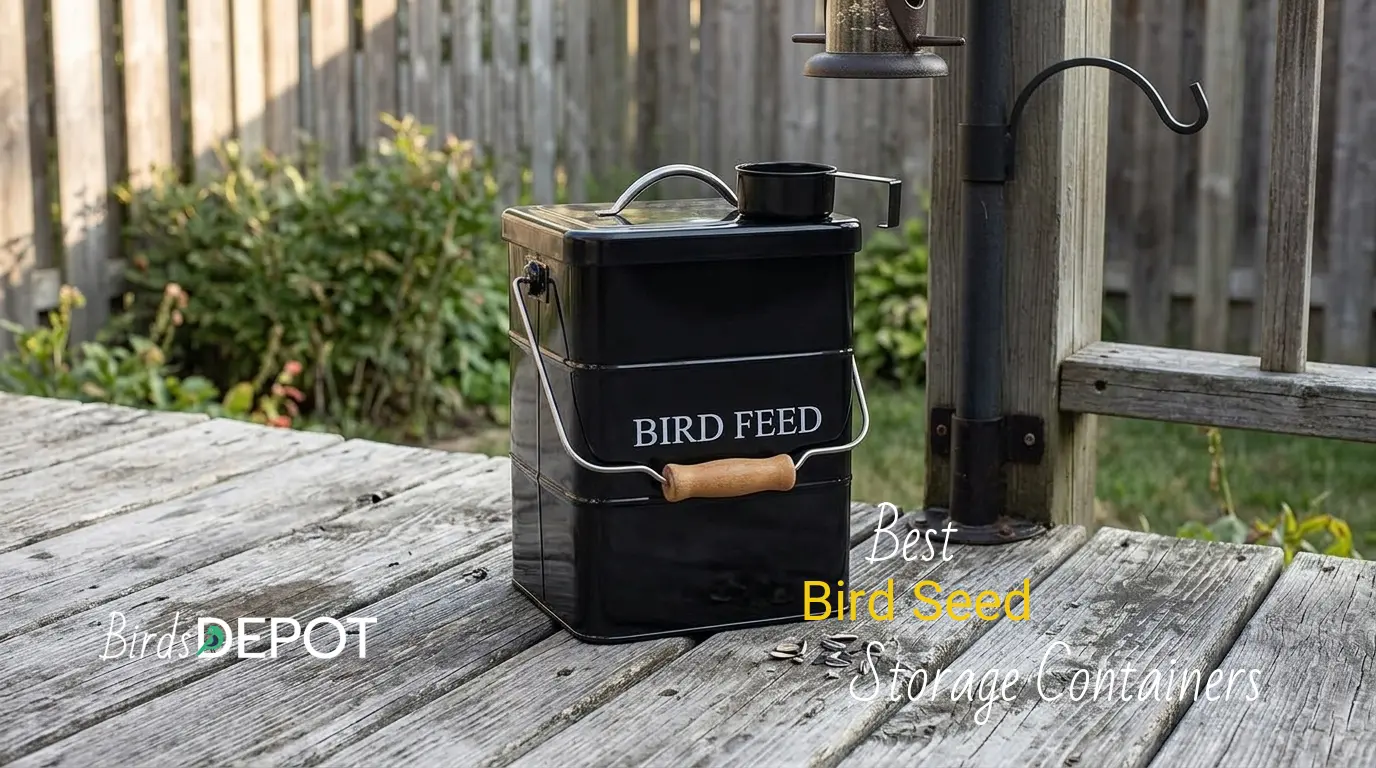
Last winter, I pulled open the garage door to refill my feeders and found a corner of my seed bag chewed clean through. A mouse had gotten into it sometime over the previous week. The seed on the floor was damp, clumped, and starting to smell. I threw out the whole bag. It’s about 8 lbs of sunflower seed, and I stood there annoyed at myself for not dealing with storage sooner.
That moment pushed me to actually sort out my best bird seed storage containers situation properly. I bought and tested the Brabtod metal tin and the SQUSIMEI plastic container myself, using both through several refill cycles. I also spent real time researching the IRIS USA WeatherPro, the More Birds Super Tote, and the Gamma2 Vittles Vault before settling on my current setup. I read through hundreds of buyer reviews, compared specs, and dug into what the birding community consistently recommends. What follows is an honest account of all five.
Why Seed Storage Matters More Than You Think
Most people treat seed storage as a convenience issue. It isn’t. A University of Guelph study reported by ScienceDaily found that up to 25% of tested wild bird feed samples exceeded the FDA’s 20 microgram/kg legal limit for aflatoxin, a mycotoxin produced by mold. Some birds, like white-winged doves and northern bobwhites, don’t reliably avoid contaminated seed either. They’ll eat it without apparent hesitation. Moldy seed isn’t just wasted money. It’s a genuine health risk to the birds you’re feeding.
Rodents are the other half of the problem. Cornell University’s New York State Integrated Pest Management program specifically recommends storing birdseed in pest-proof containers “to avoid fueling a rodent population explosion.” Exposed or poorly sealed seed is a reliable attractant. Anne Arundel County health guidance points to sealed storage as one of the primary rodent-prevention measures, alongside catch trays to reduce spillage. If you’re already working on keeping rodents away from your feeders entirely, proper seed storage is the logical next step.
What to Look For in a Bird Seed Storage Container
- Material: Metal is the only material mice and squirrels cannot chew through. Galvanized steel or powder-coated iron wins for any outdoor or garage setup. Hard plastic works fine for indoor storage where rodent pressure is low, but don’t count on it stopping a determined mouse. Agricultural extension guidance suggests seed stored between 40°F and 70°F at under 60% relative humidity stays fresh longest, so where you store matters as much as what you store it in.
- Seal quality: A snap-on lid is not an airtight seal. Look specifically for silicone gaskets, threaded locking lids, or multi-point latches. A real airtight seal keeps moisture out, slows oxidation, and prevents the conditions mold needs to grow. If the product description only says “tight-fitting lid,” that’s a soft claim worth treating with skepticism.
- Capacity relative to your setup: Overbuying capacity sounds smart but isn’t. Seed sitting in a half-empty container still ages. Match the container size to roughly four to six weeks of your actual usage. A single feeder setup rarely needs more than 10 lbs at a time. Three or more feeders running simultaneously might justify a 20 lb bin.
- Ease of filling and scooping: Wide openings matter more than they sound. Narrow-mouth containers make it easy to spill seed on the way in and create blind spots when you’re checking how much is left. A scoop that stores inside the container keeps your setup tidy and means one less thing to track down at 7am.
- Outdoor vs. indoor placement: Plastic containers stored outdoors in full sun can warp and compromise the seal over a single season. If the container lives outside year-round, metal is the right call. For indoor or covered storage, a well-sealed plastic or BPA-free acrylic tote is perfectly adequate and often easier to clean.
Our Top Picks for Best Bird Seed Storage Containers
- Brabtod Metal Seed TinBest Small Metal Container
- SQUSIMEI Airtight Seed ContainerBest Compact Indoor Option
- IRIS USA WeatherPro BinBest for Medium Quantities
- More Birds Super ToteBest for Feeder Filling
- Gamma2 Vittles VaultBest High-Capacity Option
The 5 Best Bird Seed Storage Containers: Detailed Reviews

Brabtod Metal Seed Tin
Best Small Metal Container
A powder-coated galvanized iron tin with a silicone-sealed lid that holds 5 to 6 lbs of seed and includes a measuring scoop that stores inside the container.
Pros
- Powder-coated galvanized iron body resists rust, rain, snow, and UV damage
- Silicone sealing ring creates a genuinely airtight, moisture-resistant closure
- Scoop stores inside the container, keeping the setup clean and compact
Cons
- At 5 to 6 lbs capacity, it won’t suit anyone running more than one or two feeders without frequent refills
The lid presses down over a silicone ring that runs around the inner rim, creating a seal that keeps air and moisture out between fills. The galvanized iron body doesn’t flex or warp, so the seal stays consistent. You lift the lid, use the included 1-cup scoop to measure out what you need, and the scoop drops back inside before you close up.
The body is powder-coated galvanized iron, 7 inches long by 6 inches wide by 9 inches tall. That coating does real work: it blocks UV and resists the kind of surface rust that shows up on uncoated metal after a wet winter. The silicone ring inside the lid is thick enough to compress properly when you close it, which is the detail that separates a genuinely airtight container from one that just claims to be.
The first morning I used this, I noticed immediately how solid the lid feels when it seats. There’s a slight resistance right at the end of the press, the point where the silicone compresses, that gives you a clear signal the seal is actually engaged. I’d been using a plastic tub with a snap lid before, and I never had that confidence. I’ve kept this one on a covered patio shelf through rain and cold and the seed inside has stayed dry and unclumped every time I’ve opened it.
Hand wash with mild soap and warm water, then dry it thoroughly before closing. The wide opening makes it easy to wipe down the interior without reaching blind corners. The powder-coat surface needs gentle treatment: no abrasive scrubbers. I do a proper wash roughly once a month and a quick wipe-down in between.
The birder who wants a metal container with a real airtight seal for a small single-feeder setup, and wants the scoop situation sorted without buying anything extra.

SQUSIMEI Airtight Seed Container
Best Compact Indoor Option
A BPA-free PP plastic container holding 2.8 liters of seed, with a 2cm silicone sealing ring, a hidden carry handle, and a top compartment for desiccant.
Pros
- 2cm thickened silicone sealing ring makes the closure genuinely moisture-proof and dust-proof
- Separate top compartment lets you add desiccant without it touching the seed
- Concealable handle folds away flat when stored, saving shelf space
Cons
- At 2.8 liters, this is a small container best suited for Nyjer or specialty seed rather than bulk sunflower
- Plastic won’t stop a determined rodent, so outdoor or garage use isn’t ideal
The flip-top lid opens on a hinge and closes down onto the 2cm silicone ring, pressing it against the container rim to create the seal. The desiccant compartment at the top sits completely separated from the seed below, so moisture-absorbing packets can work without any risk of contaminating what the birds eat. The handle folds up when you’re moving the container and presses flat against the side when you set it down.
The body is BPA-free PP plastic with a rectangular shape that stacks cleanly on a shelf. It’s dishwasher safe and freezer safe, which makes it genuinely versatile. The silicone sealing ring is the standout construction detail here: at 2cm thick, it’s noticeably chunkier than the thin rings you find on budget food containers, and that thickness is what makes the seal hold up over repeated openings.
I keep this one on the kitchen counter for my balcony feeder, which only goes through Nyjer and small mixed blends. The first thing I noticed when I opened the box was how deliberately the desiccant compartment is designed: it’s a separate plastic tray that lifts out, not just a divider. I dropped a silica packet in there the first week and the seed has stayed noticeably free-flowing even through a humid stretch we had in late spring. The hidden handle is a small detail but a genuinely useful one when you’re carrying it out to the balcony with one hand and holding the feeder with the other.
The product details confirm it’s dishwasher safe, which makes proper cleaning much easier than most seed containers. The rectangular shape means the interior corners are square and reachable. I hand wash it monthly and run it through the dishwasher if I’m switching seed types.
Anyone with a small balcony setup or a single specialty-seed feeder who wants a compact, genuinely airtight container for indoor or covered storage.

IRIS USA WeatherPro Bin
Best for Medium Quantities
A translucent BPA-free plastic bin holding up to 10 lbs of seed with snap-lock latches, a wide top opening, and a clear body for checking seed levels at a glance.
Pros
- Translucent body lets you check seed level without opening the container
- Snap-lock latches and wide top opening make scooping and cleaning straightforward
- Made in the USA, BPA-free, with nearly 89,000 Amazon reviews behind it
Cons
- Plastic construction means rodents can chew through it if it’s stored in a garage or shed with mouse pressure
- Hand wash only, which adds time given the larger capacity
The lid opens wide across the full top of the container, which means no awkward angling of a scoop to reach the bottom. Snap-lock latches on the sides click down to hold the lid closed and create the airtight seal. The translucent body works as a passive level indicator: you can see from across the garage whether you’re running low before you make the trip to the feed store.
The container measures 11.62 inches long by 9.07 inches wide by 12.40 inches tall and weighs 1.2 lbs empty. BPA-free plastic throughout. The snap-lock latch mechanism is the structural detail that matters here: it’s a positive, audible lock rather than a friction-fit lid, which makes a meaningful difference to how reliably the seal holds over time.
What kept coming up in reviews was the sheer consistency of the seal over long periods. Buyers with this container for two or three years were still reporting dry seed and no pest intrusion in indoor settings. The spec that caught my attention was the wide-top opening combined with the full 10 lb capacity, which matches my typical purchase size for sunflower seed exactly. What made me choose differently was the material: my storage spot has had mouse activity, and I wasn’t willing to bet on plastic. For anyone storing indoors without rodent pressure, this is genuinely one of the most proven containers in this category.
Hand wash only, which is the one real friction point given the size. The wide opening helps: you can get your hand or a sponge into every corner without difficulty. A monthly wash takes about five minutes.
The backyard birder with indoor or covered storage who goes through roughly 10 lbs of seed every few weeks and wants a proven, easy-to-monitor container without paying premium prices.

More Birds Super Tote
Best for Feeder Filling
A 5 lb capacity clear plastic seed tote with a tapered pour spout, easy-grip handle, and stackable design built specifically for carrying and dispensing seed directly into feeders.
Pros
- Tapered pour spout eliminates spillage when filling feeders directly from the container
- Stackable and lightweight at 16 oz empty, making it easy to store multiples for different seed types
- 4.8 stars across nearly 4,000 reviews, the highest-rated product in this group
Cons
- 5 lb capacity is a secondary storage vessel, not a bulk storage solution
- Plastic construction offers no rodent resistance
This one works differently from the other containers here. It’s designed as a dispenser you carry to the feeder, not a long-term storage bin. You fill it from your main storage container, carry it out by the easy-grip handle, and pour directly into the feeder through the tapered spout. The lid seals to protect seed between trips.
Clear plastic body, 7.72 inches long by 6.9 inches wide by 15 inches tall, weighing just 16 ounces empty. The stackable design means you can run two or three of these, one per seed type, and they nest cleanly in a cabinet or on a shelf. The pour spout is the main design feature worth noting: it tapers to a controlled opening that lets you direct seed into a feeder port without scattering half of it on the ground.
Buyers consistently mentioned how much the pour spout changed the actual experience of filling feeders. Multiple reviewers specifically noted they’d stopped spilling seed on the ground entirely, which matters both for keeping the area tidy and for reducing the loose seed that attracts rodents. The spec that caught my attention was the stackable design: I run three different seed types simultaneously, and the idea of dedicated labeled totes for each was appealing. I ultimately decided I needed a true bulk storage solution first, and this is a companion piece rather than a standalone answer. It would pair well with the Brabtod or the Gamma2 as your carry vessel.
The clear body lets you see any residue or clumping before it becomes a problem. Rinse and wipe between seed types. The wide opening makes it simple to clean without tools.
The birder who fills multiple feeders regularly and wants a dedicated dispensing vessel that cuts spillage and makes the refill routine faster.

Gamma2 Vittles Vault
Best High-Capacity Option
A 20 lb capacity HDPE bin with patented Gamma Seal Technology, featuring a threaded locking lid and double gaskets for a genuinely airtight, pest-resistant seal.
Pros
- Patented threaded locking lid with double gaskets creates one of the most reliable airtight seals in this category
- Food-grade BPA-free HDPE plastic won’t shatter if dropped and can be used indoors or outdoors
- 20 lb capacity covers a multi-feeder setup for four to six weeks without restocking
Cons
- HDPE plastic, while durable, is still not chew-proof against determined rodents the way metal would be
- At 12 inches by 12 inches by 18 inches and 3.5 lbs empty, it’s a substantial footprint for smaller storage spaces
The Gamma Seal lid screws on via a threaded ring, and two gaskets compress as you turn it, creating a controlled moisture barrier rather than just a pressure fit. You twist to open, scoop what you need, and twist to close. The threading means the seal doesn’t degrade from repeated openings the way a snap-fit lid can over time.
Food-grade HDPE plastic throughout, made in the USA and backed by a one-year warranty. At 12 inches by 12 inches by 18 inches, it’s a proper bulk bin. The HDPE won’t crack in cold temperatures or warp in heat, which makes it more durable than standard plastic containers in variable storage conditions. The stackable design works if you want to run two vaults side by side for different seed blends.
What kept coming up in reviews was how the seal holds up after years of use. Buyers who’d owned this for five or more years were still reporting no moisture intrusion and no pest problems in garage storage. The spec that caught my attention was the double gasket system: most containers have one seal, and the second gasket here is specifically what handles the moisture-balance control that Gamma markets as their core technology. What gave me pause was the rodent situation in my own garage. Multiple reviewers mentioned mice had gotten through the HDPE in high-pressure situations, which isn’t surprising given that plastic, however thick, isn’t metal. If my storage were indoors or in a rodent-free space, this would be my bulk container without question.
Hand washes only. The threaded lid unscrews completely, giving you full access to the interior. The wide opening handles a sponge or cloth without difficulty. The size means cleaning takes a bit more effort than the smaller containers here, but the design doesn’t create any hard-to-reach spots.
The serious backyard birder running three or more feeders who wants a high-capacity, genuinely airtight container for indoor or low-rodent-pressure garage storage.
How to Store Seed So It Actually Stays Fresh
The container is only half the equation. Agricultural storage guidance puts the ideal range at 40°F to 70°F with relative humidity below 60%. A sealed container in a hot, damp garage still creates conditions where seed degrades faster than it should.
The habit that matters most is not topping up old seed with new. Pouring fresh seed on top of older seed buries the older material at the bottom where it sits longest. Empty the container fully, inspect for clumping or off smells, then refill. Nyjer seed has a shorter shelf life than sunflower or mixed blends, and Nyjer seed freshness is worth monitoring more closely if you’re running thistle feeders. The same storage principles apply to suet if you keep packaged bird suet on hand. If you’re not sure whether seed has already turned, the practical guide on how to tell if your seed has already gone bad is worth reading before you fill your next feeder.
When a Container Isn’t Enough on Its Own
Even a sealed container won’t solve everything if seed is scattering under your feeders and sitting on the ground. Spilled seed is the primary attractant for rats and mice, regardless of how well your storage is locked down. Catch trays under feeders reduce ground scatter significantly, and feeder placement away from walls and cover limits the approach routes rodents prefer.
For the full picture on managing rodent pressure around your setup, the guide on keeping rodents away from your feeders entirely covers placement and physical deterrents in detail. If squirrels are the bigger problem at your feeders, the squirrel-proof feeder options guide is worth reading alongside this one.
Final Verdict: My Top Pick
- Best for outdoor or garage storage with rodent pressure: The Brabtod Metal Seed Tin. It’s the only metal container in this group, which means it’s the only one that physically stops chewing. The silicone seal and powder-coated body handle moisture and weather. The 5 to 6 lb capacity suits a single-feeder setup well.
- Best for indoor compact storage: The SQUSIMEI Airtight Container. The 2cm silicone ring and desiccant compartment make it the most thoughtfully sealed small container here. It’s the one I reach for on my balcony setup.
- Best for medium indoor quantities: The IRIS USA WeatherPro. Nearly 89,000 reviews don’t lie about consistency. The translucent body and wide opening make it the most practical daily-use container for a single indoor setup going through 10 lbs at a time.
- Best companion dispenser: The More Birds Super Tote. Don’t use this as your primary storage. Do use it as your carry vessel for filling feeders. The pour spout genuinely changes the refill experience.
- Best for high-volume setups in low-rodent conditions: The Gamma2 Vittles Vault. The double-gasket threaded lid is the most engineered seal in this group. For anyone running three or more feeders indoors or in a clean garage, 20 lbs of properly sealed storage is hard to beat.
My overall pick is the Brabtod Metal Seed Tin for anyone dealing with rodent pressure, and the Gamma2 Vittles Vault for anyone who isn’t. Those are the two scenarios that matter most, and those are the containers that solve them most directly.
If you’re ready to pick one, the Brabtod is available on Amazon here and the Gamma2 Vittles Vault is here.
Frequently Asked Questions
For outdoor or garage storage where rodents are a concern, a metal container with a locking lid is the right answer. Plastic, however thick, can be chewed through. For clean indoor storage, a hard plastic bin with a genuine gasket seal works well and is easier to clean.
Yes, and specifically spilled or improperly stored seed is the main culprit. Cornell University’s NYSIPM program recommends pest-proof containers as a direct measure against rodent population problems near bird feeders. The seed in a properly sealed container isn’t the issue. The seed on the ground or in a poorly sealed bag is.
It can, and it is. A University of Guelph study found that up to 25% of tested wild bird feed samples exceeded the FDA’s legal limit for aflatoxin, a mycotoxin produced by mold. Birds don’t reliably avoid contaminated seed, so the risk lands on them directly. Dry, cool, airtight storage is what prevents mold from developing in the first place.
Most seed stays fresh for roughly six months after opening if stored correctly below 70°F and below 60% humidity. Nyjer seed has a shorter window than sunflower or mixed blends. The freshness question gets more complicated once seed has been exposed to heat, moisture, or air for any length of time.
Either location works if the container is properly sealed and rodent-resistant. Outdoor storage needs a metal container. Plastic containers in a garage or shed with any rodent activity are not reliable long-term. Indoor storage in a cool, dry spot with a quality airtight container is the easiest setup to get right consistently.