

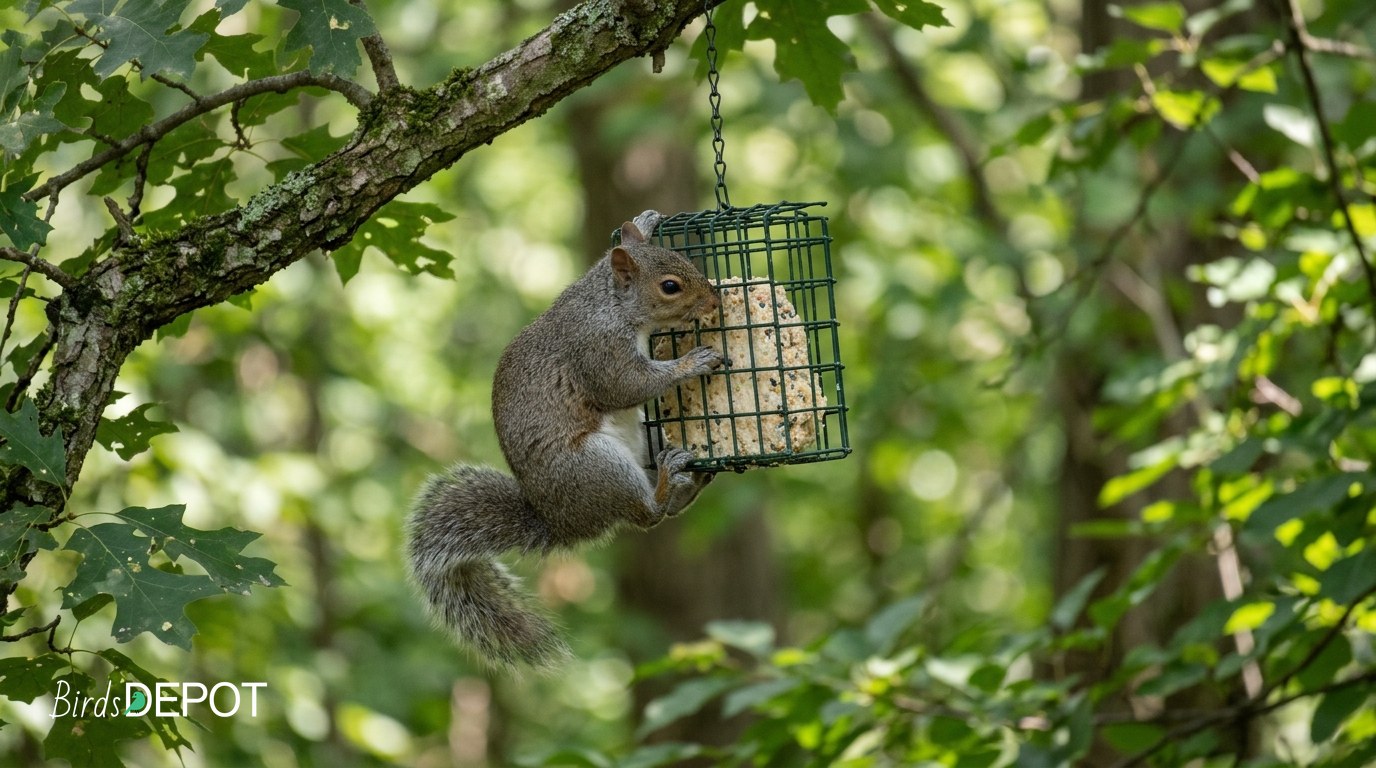
If squirrels keep emptying your suet cage before the woodpeckers get a turn, you’re not imagining it. Suet is dense, high-energy food, and squirrels want it just as much as the birds do. A plain wire cage barely slows them down.
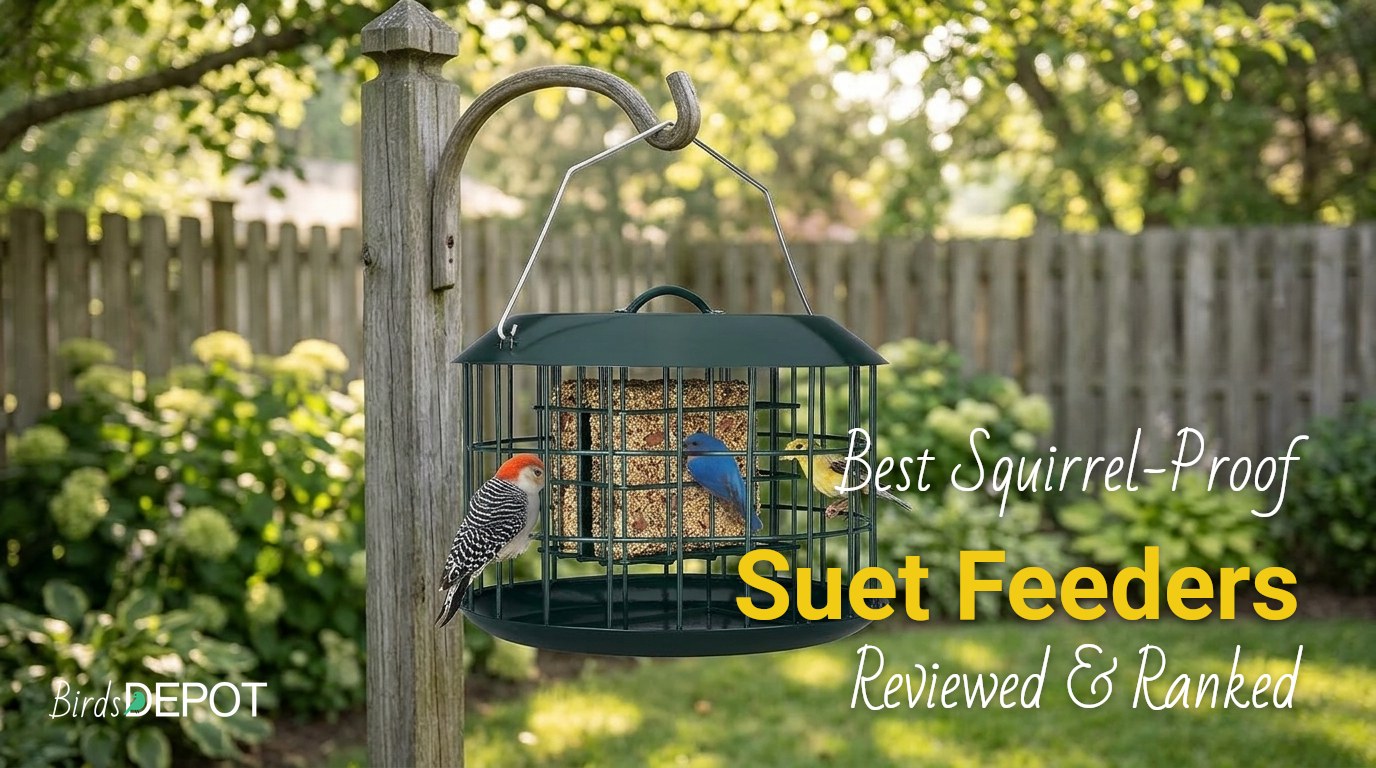
So I went through buyer reviews, published tester reports, and product specs to see which squirrel-proof suet feeders actually hold up. None of the five products below are ones I’ve used myself. What I can tell you is what the data shows, what independent testers found, and where each design has real limits. One thing worth saying upfront: no suet feeder is truly 100% squirrel-proof on its own. Placement matters as much as the feeder design. I’ll get into that throughout.
- Weight-activated shroud (Brome Squirrel Buster Suet): The most engineered approach. A spring-loaded shroud drops and blocks access when a squirrel lands. The most reliable mechanism available, but it needs 18 inches of clearance on all sides to work properly.
- Cage-style with tight mesh (Kingsyard, Winemana, Gbekery): Small openings let target birds in but physically block adult squirrels. Simpler, usually cheaper, and still effective when hung in the right spot.
- Dome baffle add-on (Beserie): Not a suet feeder at all. A 14-inch dome that mounts above any hanging feeder to block squirrels before they can even reach the cage below. The smart pairing for a basic suet cage.
Key Considerations When Choosing a Squirrel-Proof Suet Feeder
- Mechanism type: Weight-activated feeders close off access automatically when something too heavy lands on them. Cage-style feeders rely on mesh openings small enough to exclude squirrels physically. Weight-activated designs are generally more reliable against determined squirrels. Cage designs are simpler, have fewer moving parts, and cost less. If you have light squirrel pressure, a good cage feeder hung correctly does the job. If your garden has persistent, athletic squirrels, the weight-activated Brome is worth the extra cost.
- Durability and materials: Metal outlasts plastic every time in an outdoor suet feeder. Squirrels chew. A powder-coated steel cage will survive that; thin plastic will not. Look for anti-rust coatings if you’re in a wet climate. The Brome uses metal with weatherproof construction. The Kingsyard, Winemana, and Gbekery are all-metal builds with anti-rust finishes.
- Ease of cleaning and filling: Suet goes rancid in warm weather. Cornell Lab of Ornithology recommends cleaning suet feeders every one to two weeks, more often in summer. A feeder with a removable roof or a detachable component system makes that realistic rather than something you put off. Check whether parts come apart by hand or require tools.
- Bird-friendliness: The mesh openings need to let your target birds through. Downy woodpeckers, nuthatches, chickadees, and titmice are small. A 1.5-inch opening is enough for them. Larger species like red-bellied woodpeckers need a bit more room, and a tail-prop extension helps them feed comfortably. Check which species you’re trying to attract before buying.
- Placement: This one gets skipped in most product listings and it shouldn’t. Bird Watcher’s Digest noted that the Brome Squirrel Buster Suet needs roughly 18 inches of clearance on all sides to prevent squirrels from reaching the suet without triggering the weight mechanism. Cage-style feeders hung within jumping range of a fence, branch, or post are still vulnerable. A dome baffle above the feeder, or a pole-mounted setup with a baffle below, closes that gap significantly.
- Suet type compatibility: Standard 5×5 suet cakes fit most feeders here. Some feeders also accept fruits, bread, or seed cakes. If you rotate food types seasonally, check what each feeder will accept before buying.
One more thing worth knowing: Cornell Lab of Ornithology estimates that North America has lost nearly 3 billion birds since 1970. Keeping feeders clean, well-stocked, and accessible to the right birds genuinely matters. A squirrel that drains your suet every two days isn’t just expensive. It’s a bird that didn’t get fed.
If you’re also looking at seed feeders, my guide to the best squirrel-proof bird feeders covers those separately.
Our Top Picks for Squirrel-Proof Suet Feeders
- Brome Squirrel Buster SuetBest Weight-Activated Squirrel-Proof Suet Feeder
- Kingsyard Squirrel Proof Suet FeederBest All-Metal Cage Feeder with Baffle Roof
- Winemana Single Suet CageBest Budget Squirrel-Resistant Suet Feeder
- Gbekery Double Suet FeederBest Heavy-Gauge Cage Feeder with Seed Tray
- Beserie Dome Squirrel BaffleBest Squirrel Baffle Add-On for Any Suet Feeder
The 4 Best Squirrel-Proof Suet Feeders (Plus a Baffle): Detailed Reviews

Brome Squirrel Buster Suet
Best Weight-Activated Squirrel-Proof Suet Feeder
A suet feeder with a patented weight-adjustable spring that physically closes off access the moment a squirrel lands. It doesn't just discourage squirrels, it blocks them.
Pros
- Patented weight-adjustable spring mechanism closes access automatically when a squirrel lands
- Crumb port catches falling suet so nothing goes to waste
- Dismantles by hand into individual parts for cleaning, no tools needed
Cons
- Needs roughly 18 inches of clearance on all sides to work as intended
- May not stop juvenile squirrels or chipmunks at default spring settings; adjusting the spring to exclude them can also shut out larger birds like pileated woodpeckers
When a bird lands to feed, its light weight doesn’t compress the spring. The shroud stays up, the feeding ports stay open, and the bird eats. When a squirrel climbs on, its heavier weight pushes the shroud down automatically, closing off the ports entirely. The squirrel is blocked but not harmed. The spring tension is adjustable, so you can calibrate exactly how much weight triggers the closure.
The feeder is metal with weatherproof construction and sits at 18.63 inches tall. It holds two standard 5×5 suet cakes and includes two crumb ports below the main feeding area. The green powder-coated finish is designed to hold up outdoors year-round. Brome backs the feeder against manufacturing defects, and the brand has a long-standing reputation in the squirrel-proof feeder category.
Why It Could Be a Good Choice
Bird Watcher’s Digest tested the Brome Squirrel Buster Suet and reported that the spring mechanism worked reliably against adult squirrels. Their tester specifically called out the crumb-catching tray as a genuinely useful feature and noted the spring is easy to adjust. Bob Vila also named it their “Best Squirrel-Proof” suet feeder pick after testing ten models. What gave me pause was the placement requirement. Bird Watcher’s Digest flagged that it needs about 18 inches of clearance on all sides, and that the default spring setting may not stop juvenile squirrels or chipmunks. Their tester pointed out that tightening the spring to exclude lighter animals can also close the feeder on larger woodpecker species. That’s a real trade-off depending on who’s visiting your garden.
The detachable component system means the whole feeder comes apart by hand, no tools required. Each part can be cleaned separately. Suet loading is described as mess-free, which matters more than it sounds when you’re handling raw suet cakes in cold weather.
Anyone dealing with persistent adult squirrels who wants a set-and-forget mechanical solution and is willing to hang the feeder with proper clearance from fences and branches.

Kingsyard Squirrel Proof Suet Feeder
Best All-Metal Cage Feeder with Baffle Roof
A fully metal cage feeder with 1.5-inch fly-through openings, a 9.8-inch weather baffle, and a removable roof that makes refilling and cleaning straightforward.
Pros
- All-metal construction with anti-rust powder coat stands up to chewing and outdoor weather year-round
- 9.8-inch diameter top baffle protects suet from sun, rain, and snow
- Removable roof for easy refilling and cleaning
Cons
- Cage-style design relies on placement to exclude squirrels; a determined squirrel that can reach the cage without triggering a weight mechanism may still get in
- 1.5-inch openings exclude adult squirrels but may not stop juveniles in close proximity
The 1.5-inch fly-through openings are sized to let small birds like downy woodpeckers, chickadees, nuthatches, and finches access the suet inside. Adult squirrels are too large to squeeze through. There’s no moving spring or weight-triggered mechanism here. The exclusion is purely physical, which makes it simple and reliable as long as the feeder is hung out of jumping range.
The entire feeder is metal with an anti-rust powder-coated finish. It holds two standard suet cakes and measures 9.8 inches wide by 7.8 inches tall. The 9.8-inch top baffle doubles as a weather shield and sits wide enough to cover the cage below it. At about 2.3 pounds, it’s light enough to hang from a shepherd’s hook without strain.
Why It Could Be a Good Choice
What kept coming up in reviews was the all-metal build at a mid-range price. Most cage feeders at this price point mix in plastic components that squirrels eventually chew through. The Kingsyard is entirely metal, and buyers consistently mentioned that it held up through multiple winters without rusting or warping. The 9.8-inch baffle roof also stood out as a genuine weather feature rather than just a decorative cap. What made me look further was the cage-only mechanism. With no weight-activated shroud, a squirrel that can reach the feeder from a nearby branch has a real shot at the suet. Pairing it with a dome baffle above would close that gap.
The roof lifts off completely for refilling. Cleaning involves removing the roof and rinsing the cage. The bottom tray catches seed drops and keeps the area underneath tidier. No tools needed for any of it.
Gardeners who want a durable all-metal cage feeder with built-in weather protection and are willing to think carefully about where they hang it.

Winemana Single Suet Cage
Best Budget Squirrel-Resistant Suet Feeder
A compact, lightweight alloy steel suet cage with a rainproof roof and anti-rust coating, sized for a single suet cake and easy to hang anywhere.
Pros
- Alloy steel build with anti-rust coating resists outdoor weather
- Protective rainproof roof keeps suet from melting in sun or spoiling in rain
- Square cage design fits standard suet cake shapes snugly
Cons
- Single cake capacity means more frequent refills than double-capacity models
- No weight-activated mechanism; squirrel resistance depends entirely on placement
The cage bars are spaced to allow birds access while physically excluding adult squirrels. There’s no spring or shroud. A bird clings to the outside of the cage and pecks through the bars to reach the suet inside. Setup is simple: remove the suspension ring and roof, drop in a suet cake, reinstall the roof, and hang it up.
The feeder is made from alloy steel and metal with a super anti-rust coating. It measures 6.5 inches long by 3.9 inches wide by 9.2 inches tall and weighs 0.3 kilograms, making it one of the lighter options here. The square cage profile fits standard suet cake dimensions well, so there’s minimal wasted space inside. The rainproof roof is a fixed feature rather than removable, which affects how you clean it.
Why It Could Be a Good Choice
The spec that caught my attention was the weight. At 0.3 kilograms, this is light enough to hang from almost anything, including a thin balcony railing hook or a small nail on a wooden fence post. Buyers consistently mentioned how easy it was to get up and running, and the compact size made it practical for smaller outdoor spaces. What kept me looking was the single-cake capacity. If you’re attracting multiple woodpeckers or a mixed flock, you’ll be refilling it every couple of days, which gets old fast. For a single feeding spot or a backup feeder, it makes sense.
The listing recommends soaking the feeder in water to remove suet residue when you change cakes. The alloy steel construction means it can handle that without rusting. The compact size makes it easy to submerge completely in a cleaning bucket.
Anyone setting up a first suet feeder on a budget, or someone who wants a lightweight second feeder for a spot where a larger cage won’t hang easily.

Gbekery Double Suet Feeder
Best Heavy-Gauge Cage Feeder with Seed Tray
A heavy-gauge metal mesh cage with a 1.7x1.7-inch grid, double suet capacity, a detachable glass bowl, and an extended seed-catching platform below.
Pros
- Heavy-gauge thicker metal mesh with a 1.7×1.7-inch grid resists chewing and bending
- Detachable glass bowl makes targeted cleaning quick and easy
- Extended metal platform below the cage catches fallen seed and gives birds extra perching room
Cons
- The listing itself notes it is not 100% squirrel-proof and recommends hanging it out of jumping range for best results
- At 2.1 pounds, heavier than comparable cage feeders, which limits where it can hang
The 1.7×1.7-inch grid openings are sized to block adult squirrels and large birds while letting smaller wild birds access the suet inside. Two suet cakes sit in the cage simultaneously. The extended metal platform below functions both as a seed tray and as a perch, giving birds more room to feed comfortably. Bottom drainage holes prevent rainwater from pooling inside and keep the food dry.
The cage is heavy-gauge metal with a weatherproof lid and a protective coating for rust resistance. It measures 9.06 inches wide by 12.05 inches tall and weighs 2.1 pounds. The detachable glass bowl is an unusual feature at this price point. It sits inside the feeder and can be removed and rinsed separately, which is more practical than trying to scrub the inside of a wire cage. The brown finish blends into garden settings more naturally than the green finishes on the Kingsyard and Brome.
Why It Could Be a Good Choice
The heavy-gauge mesh was what stood out. Most cage feeders at this price use standard wire that determined squirrels can bend or eventually chew through. The thicker grid here is specifically designed to resist that. Buyers consistently mentioned the solid feel of the construction and how the seed tray below reduced the mess under the feeder noticeably. The honest note in the product listing itself, acknowledging it’s not 100% squirrel-proof and recommending placement out of jumping range, actually made me trust it more rather than less. That’s an accurate description of how any cage feeder works.
The roof lifts off for refilling. The detachable glass bowl pulls out for a separate rinse. Drainage holes in the bottom mean water doesn’t sit after rain. For a double-capacity feeder, the maintenance setup is well thought out.
Gardeners who want a sturdy double-capacity cage feeder with a practical cleaning system and don’t mind the extra weight.

Beserie Dome Squirrel Baffle
Best Squirrel Baffle Add-On for Any Suet Feeder
A 14-inch dome that mounts above any hanging feeder using two hooks, blocking squirrels from above while shielding suet from rain and direct sun.
Pros
- 14-inch diameter creates a wide physical barrier squirrels struggle to reach around
- Built-in ant moat and rain protection work alongside the squirrel deterrent function
- Mounts with two hooks above any existing hanging feeder without modification
Cons
- Plastic construction is less durable than metal options long-term, especially in strong sun or cold
- Only blocks squirrel access from above; a feeder hung near a branch or fence post can still be reached from the side
This is not a suet feeder. It’s a dome-shaped baffle that hangs above any existing hanging feeder. Squirrels trying to descend the hanger wire hit the dome and can’t get around it or past it to reach the feeder below. The dome is 14 inches in diameter, which is wide enough that a squirrel can’t span it from the edge to the hanger. It also keeps rain and direct sun off the feeder below, which extends suet life in warmer months.
The dome is high-quality plastic, 14 inches wide by 4.1 inches deep, and weighs 14.4 ounces. It comes in green and mounts using two included hooks. The ant moat is built into the dome’s center, which is a practical bonus if you’re also dealing with ants reaching a hummingbird feeder or nectar source. The plastic material means it’s lighter and easier to install than a metal baffle, but it will show UV wear over time.
“Why It Could Be a Good Choice
The spec that caught my attention was the 14-inch diameter. Most cheap dome baffles run 10 to 12 inches, which is narrow enough for a flexible squirrel to work around. At 14 inches, the math gets much harder for them. Buyers consistently mentioned pairing this dome with a plain wire suet cage they already owned, essentially upgrading a basic feeder into something far more squirrel-resistant without replacing it entirely. That’s a smart approach, and it’s cheaper than buying a new weight-activated feeder. The limitation is real though: it only protects from above. If your feeder hangs near a fence or branch a squirrel can jump from sideways, the dome doesn’t help.
The dome wipes clean easily. The ant moat requires occasional refilling with water. Removing it from the hanger takes seconds if you need to clean the feeder below.
Anyone who already has a plain suet cage and wants to significantly improve its squirrel resistance without buying a whole new feeder.
Final Verdict: My Top Pick
- For maximum squirrel exclusion: The Brome Squirrel Buster Suet is the clear answer. The weight-activated shroud is the only mechanism here that blocks squirrels regardless of how they approach the feeder, as long as you give it 18 inches of clearance on all sides. Bird Watcher’s Digest and Bob Vila both tested it and rated it as the best squirrel-proof suet feeder available. It costs more than any cage option here, and it earns that price.
- For a durable all-metal cage at mid-range price: The Kingsyard Squirrel Proof Suet Feeder. Fully metal, anti-rust powder coat, a proper weather baffle, and a clean refill system. Pair it with the Beserie dome baffle above it and you have a very capable setup for a lot less than the Brome.
- For a tight budget or a secondary feeding spot: The Winemana Single Suet Cage. Lightweight, simple, holds up outdoors, and easy to move around. Just hang it well away from any jumping-off point.
- For heavy-duty construction and a practical cleaning system: The Gbekery Double Suet Feeder. The heavy-gauge mesh is the most chew-resistant cage option here, and the detachable glass bowl is genuinely useful. I appreciate that the listing is honest about its limits.
- For upgrading a feeder you already own: The Beserie Dome Squirrel Baffle. If you already have a suet cage in the garden, this is the fastest and cheapest upgrade you can make.
My overall pick is the Brome Squirrel Buster Suet. It’s the only feeder here where the squirrel exclusion is mechanical and automatic rather than placement-dependent. If you’re losing suet regularly and you’re done experimenting, that’s the one to buy.
For more options beyond suet, my guide to the best suet feeders covers a wider range of styles including tail-prop models and combination seed-and-suet setups.
Frequently Asked Questions
At least 10 feet from any horizontal surface a squirrel can jump from, and ideally higher. Grey squirrels can jump roughly 5 feet vertically and up to 10 feet horizontally from a standing position. The Brome Squirrel Buster Suet specifically needs 18 inches of clearance on all sides for its weight mechanism to work correctly. Cage-style feeders with no moving mechanism need to be completely out of jumping range to stay effective.
Cage-style feeders with 1.5-inch openings exclude most large birds along with squirrels. The Brome Squirrel Buster Suet handles this differently: its weight-adjustable spring can be tightened to exclude heavier birds, but doing so may also close the feeder on large woodpecker species like pileated woodpeckers. It’s a trade-off you set based on what’s visiting your garden.
Every one to two weeks in cool weather. In summer, suet spoils faster and the feeder needs cleaning more often, especially in direct sun. A feeder with a removable roof or detachable parts makes that realistic. Soaking in warm soapy water followed by a rinse is enough for most metal cage feeders.


